In the popular imagination, ISO certification is often viewed as a bureaucratic mountain reserved for multinational corporations with endless budgets and armies of compliance officers.
However, for Small and Medium Enterprises (SMEs), ISO 27001 (Information Security) is effectively a “VIP pass” to bigger markets. It is no longer just a defensive shield against hackers; it is an offensive tool to win enterprise clients who simply won’t sign contracts without it.
This article explores why ISO 27001 is becoming the gold standard for SMEs and how to navigate the journey without drowning in paperwork.
What is ISO 27001?
At its core, ISO 27001 is the international standard for an Information Security Management System (ISMS). Unlike a simple antivirus or a firewall, an ISMS is a framework of policies and procedures that includes all legal, physical, and technical controls involved in an organization’s information risk management processes.
It helps you manage the three pillars of information security, often called the CIA Triad:
- Confidentiality: Only authorized people can access data.
- Integrity: Data can only be changed by authorized people.
- Availability: Data is accessible to authorized people whenever they need it.
3 Reasons Why SMEs Are rushing to Certify
1. The “Enterprise Gatekeeper”
Large enterprises are increasingly risk-averse. When a bank, a hospital, or a government agency looks for vendors, their procurement teams have strict checklists.
The Reality: You might have the best product or service in the market, but if you cannot prove you are secure, the door is closed. ISO 27001 is an internationally recognized badge that instantly answers the question, “Can we trust you with our data?”
2. Operational Discipline (Taming the Chaos)
Startups and small businesses often run on “tribal knowledge”—processes exist only in the founders’ heads. Implementing ISO 27001 forces you to document who has access to what and why. This clarity reduces onboarding time for new hires, minimizes human error, and ensures the business doesn’t grind to a halt if a key IT manager goes on vacation.
3. Compliance Efficiency
Instead of trying to comply individually with GDPR, HIPAA, and CCPA, ISO 27001 provides a central framework that overlaps with roughly 75-80% of most other privacy regulations. It acts as a “compliance umbrella,” saving you from reinventing the wheel for every new regulation.
The Certification Roadmap: A 5-Step Guide
If you are a small business owner, the process can be broken down into five manageable phases.
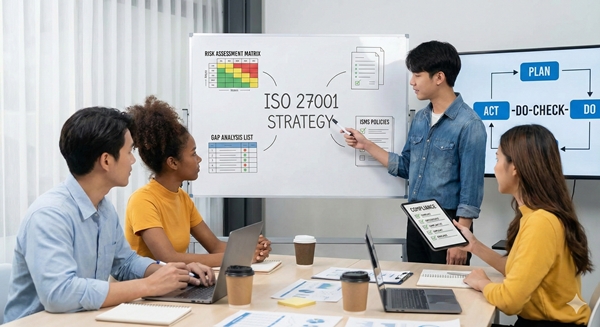
Phase 1: The Gap Analysis
Before you fix anything, you need to know what’s missing. You compare your current security setup (even if it’s just “we have strong passwords”) against the ISO 27001 requirements.
- Output: A “to-do” list of missing controls.
Phase 2: Risk Assessment & Treatment
This is the heart of the standard. You don’t need to lock down everything—only the risks that actually matter to your business.
- Identify Risks: e.g., “Losing a laptop with client data.”
- Treat Risks: e.g., “Implement full-disk encryption and remote wipe capabilities.”
Phase 3: Documentation & Training
You must write down your policies (e.g., Access Control Policy, Remote Work Policy). Crucially, you must train your staff. An ISMS fails if employees don’t know that writing passwords on sticky notes is a violation.
Phase 4: Internal Audit
Before inviting the official auditors, you conduct a “practice run.” This can be done by a trained employee or an external consultant. They check your work to ensure you are ready for the real deal.
Phase 5: The External Audit (The Finish Line)
This happens in two stages:
- Stage 1 (Document Review): The auditor checks your paperwork to see if the design of your system meets the standard.
- Stage 2 (Implementation Audit): The auditor interviews staff and observes processes to ensure you are actually doing what your documents say you are doing.
The Cost vs. Value Equation
For a small business, the cost of certification (consultants + audit fees) typically ranges from $15,000 to $40,000, depending on complexity and location.
While this is a significant layout, the Return on Investment (ROI) is often realized within the first year. Securing just one enterprise contract that requires ISO 27001 usually covers the entire cost of implementation.
Final Verdict
ISO 27001 is not just about avoiding fines or hackers; it is about business maturity. It signals to the world that you have grown up, that you are resilient, and that you are ready to play in the big leagues.