
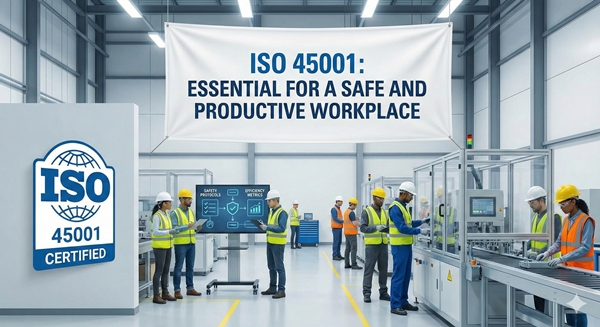
Employee safety is a priority that no business can afford to overlook. Workplace accidents, health hazards, and unsafe practices not only harm workers but also disrupt productivity, increase operational costs, and damage organizational reputation. To effectively address these challenges, organizations around the world are adopting ISO 45001, the internationally recognized standard for Occupational Health & Safety Management Systems (OHSMS).
ISO 45001 provides a structured approach to identifying risks, preventing incidents, and fostering a strong safety culture where employees feel protected and valued.

1️⃣ Proactive Risk Prevention Instead of Reactive Solutions
ISO 45001 emphasizes hazard identification and risk control before an incident occurs.
This proactive strategy helps organizations:
- Eliminate unsafe conditions
- Reduce workplace injuries and illnesses
- Prevent production downtime
- Maintain compliance with local safety laws
Preventing accidents isn’t just ethical—it’s economical.
2️⃣ Improved Employee Morale and Engagement
When employees feel safe, they work with confidence.
ISO 45001 encourages:
- Active employee participation in safety programs
- Transparent communication
- Training and awareness on workplace risks
A safer workplace leads to higher morale, lower absenteeism, and greater productivity.
3️⃣ Demonstrating Responsibility Builds Trust
In an era where social responsibility matters, ISO 45001 certification shows that the organization:
- Cares about the well-being of its people
- Is committed to global safety standards
- Operates responsibly and professionally
This increases customer trust, investor confidence, and brand credibility.
4️⃣ Better Legal Compliance and Reduced Liability
Health and safety regulations are becoming stricter worldwide.
ISO 45001 helps organizations:
- Stay compliant with government requirements
- Prevent penalties or shutdowns due to violations
- Maintain prepared documentation for inspections and audits
Compliance is easier—and safer—when risks are managed systematically.
5️⃣ Continuous Improvement Strengthens Long-Term Safety Performance
ISO 45001 is built on the Plan–Do–Check–Act (PDCA) cycle, ensuring:
- Ongoing evaluation of safety performance
- Improvement in safety processes
- Rapid response to new risks or incidents
This creates a sustainable workplace safety culture that evolves with time.
Conclusion
ISO 45001 is more than a certification—it is a commitment to protecting people. By adopting it, organizations reduce workplace risks, enhance workforce well-being, and improve business performance. A safe workforce is a productive workforce, and ISO 45001 helps ensure that every employee goes home healthy and unharmed.
Investing in workplace safety means investing in your future success.